Physics 1 Practice

Unit 8 of 8

Fluids

Density, pressure and depth, buoyancy and Archimedes’ principle, and fluid flow with continuity and Bernoulli’s equation.

10 problems: 6 multiple choice, 1 multiple select, 3 free response. Use g = 10 m/s² throughout.

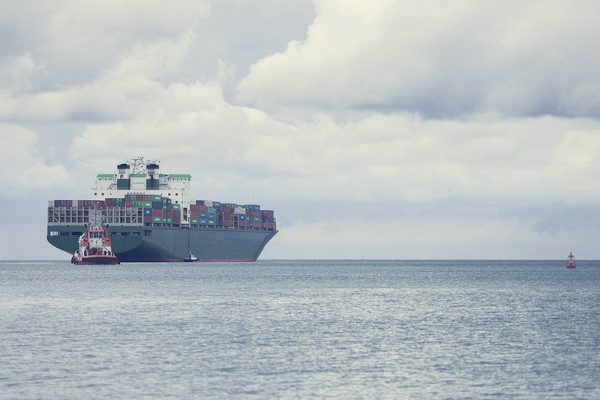
A fully loaded container ship floating on calm gray-blue sea under a cloudy sky

Photo: Martin Dörsch, CC0 1.0 Universal Public Domain Dedication. Image credits

Overview

A fluid is anything that flows, liquids and gases alike. Density, ρ = m/V, tells you how much mass is packed into a given volume. Pressure is force per area, and inside a fluid it pushes in every direction. Pressure increases with depth because each layer of fluid supports the weight of the fluid above it.

Buoyancy comes from that pressure difference. The bottom of a submerged object is deeper than its top, so the fluid pushes up on it harder than it pushes down. Archimedes' principle says the upward buoyant force equals the weight of the fluid the object pushes aside. An object floats if it can displace its own weight of fluid before it's completely underwater.

Moving fluids follow two rules. Continuity: for a liquid that can't be compressed, the volume flow rate A v is the same everywhere along a pipe, so the liquid speeds up where the pipe narrows. Bernoulli's equation is conservation of energy for a moving fluid: where the fluid moves faster or sits higher, its pressure is lower.

Key equations

EquationWhat it’s for
ρ = m / VDensity. Fresh water: 1000 kg/m³.
P = F / APressure. 1 Pa = 1 N/m². Atmospheric pressure is about 1.0 × 10⁵ Pa.
P = P0 + ρ g hAbsolute pressure at depth h. The ρ g h part alone is the gauge pressure.
Fb = ρfluid Vdisp gBuoyant force (Archimedes’ principle).
A1 v1 = A2 v2Continuity equation for a liquid.
P1 + ρ g y1 + ½ ρ v12 = P2 + ρ g y2 + ½ ρ v22Bernoulli’s equation along a streamline.

All of these are on the printable equation sheet.

Common mistakes

  • Thinking the buoyant force depends on the object's weight or density. It depends only on the volume of fluid displaced and the density of the fluid.
  • Thinking a container's shape affects the pressure at its bottom. Only the depth and the type of fluid matter.
  • Mixing up gauge pressure and absolute pressure.
  • Expecting the pressure to be higher where a fluid moves faster. In steady flow it's the other way around.
  • Forgetting that 1 cm² is 1 × 10⁻⁴ m², not 1 × 10⁻² m².

Practice problems

Work each problem on paper before opening its solution. Multiple-select problems have exactly two correct answers.

1Problem 1, Multiple choice

  • Conceptual

Three open containers are filled with water to the same depth. How does the water pressure at the bottom of each container compare?

123
  1. Choice A: It is greatest in container 1, the widest.
  2. Choice B: It is greatest in the container that holds the most water.
  3. Choice C: It is the same in all three containers.
  4. Choice D: It is greatest in container 2, the narrowest.
Show solutionHide solution

Worked solution

The pressure at depth h is P0 + ρ g h. All three have the same fluid and the same depth, so the pressure at the bottom is the same.

The wide container does hold more water, and its bottom feels a larger total force. But it has a larger area too, so the force per area, the pressure, is the same.

Answer: C.

2Problem 2, Multiple choice

  • Calculation

A block of wood floats in fresh water with three-fourths of its volume below the surface. What is the density of the wood?

  1. Choice A: 250 kg/m³
  2. Choice B: 750 kg/m³
  3. Choice C: 1000 kg/m³
  4. Choice D: 1330 kg/m³
Show solutionHide solution

Worked solution

For a floating object, the buoyant force equals the weight: ρwater Vsub g = ρwood V g.

ρwood = ρwater (Vsub/V) = (1000)(3/4) = 750 kg/m³.

Choice A uses the fraction above the water. Choice D is greater than water's density, which would make the block sink.

Answer: B.

3Problem 3, Multiple choice

  • Which changes
  • Conceptual

A diver is 5.0 m below the surface of a freshwater lake. She swims down to a depth of 10.0 m. Atmospheric pressure is 1.0 × 10⁵ Pa. Compared with the absolute pressure on her at 5.0 m, the absolute pressure at 10.0 m is

  1. Choice A: exactly twice as large
  2. Choice B: larger, but less than twice as large
  3. Choice C: more than twice as large
  4. Choice D: the same, because water can’t be compressed
Show solutionHide solution

Worked solution

Absolute pressure has two parts: the atmosphere pressing on the lake's surface, P0, and the water above the diver, ρ g h.

Doubling the depth doubles the water's part: from (1000)(10)(5.0) = 5.0 × 10⁴ Pa to 1.0 × 10⁵ Pa. The atmosphere's part doesn't change.

Total at 5.0 m: 1.5 × 10⁵ Pa. Total at 10.0 m: 2.0 × 10⁵ Pa. That's about 1.3 times as large, so more, but not twice as much. Choice A would be right for gauge pressure.

Answer: B.

4Problem 4, Multiple select

  • Conceptual

Water flows steadily through a horizontal pipe that narrows from a cross-sectional area of 4.0 cm² to 1.0 cm². In the wide section the water moves at 2.0 m/s. Which two statements are correct? Select two answers.

A = 4.0 cm²A = 1.0 cm²
  1. Choice A: The water moves at 8.0 m/s in the narrow section.
  2. Choice B: The water moves at 0.50 m/s in the narrow section.
  3. Choice C: The pressure is lower in the narrow section.
  4. Choice D: The pressure is the same in both sections, because the pipe is horizontal.
Show solutionHide solution

Worked solution

Continuity: A1 v1 = A2 v2, so (4.0)(2.0) = (1.0) v2 and v2 = 8.0 m/s. The areas are in the same units, so there's no need to convert. A is correct.

The pipe is horizontal, so Bernoulli's equation reduces to P + ½ ρ v2 = constant. Where v is larger, P is smaller. C is correct.

Physically, the water speeds up as it enters the narrow section, so there must be a net force pushing it forward. That force comes from higher pressure behind it, in the wide section.

Answers: A and C.

5Problem 5, Free response

  • Ranking
  • Paragraph argument
Four objects have the same volume. Each is in a tank of fresh water.
  • A: a wooden block floating with half its volume underwater
  • B: an aluminum cube resting on the bottom of the tank
  • C: a steel cube resting on the bottom of the tank
  • D: a plastic ball held completely underwater by a string tied to the bottom of the tank
  1. Rank the objects by the buoyant force on them, from greatest to least.
  2. A student says the steel cube has the smallest buoyant force because it sinks. Explain the error in this reasoning.
Show solutionHide solution

Model answer

(a) The buoyant force equals the weight of the water displaced, ρwater Vdisp g. B, C, and D are completely underwater, so each displaces its full volume. A displaces only half its volume.

Ranking: B = C = D > A.

(b) Whether an object sinks depends on how its weight compares with the buoyant force, not on the buoyant force alone. The steel cube feels exactly the same buoyant force as the aluminum cube and the plastic ball, because it displaces the same volume of water. It sinks because its weight is much larger than that buoyant force.

6Problem 6, Multiple choice

  • Which changes

A large open water tank has two small holes in its side. Water comes out of hole 1, which is 0.80 m below the water’s surface, at 4.0 m/s. Hole 2 is 3.2 m below the surface. About how fast does water come out of hole 2?

  1. Choice A: 4.0 m/s
  2. Choice B: 8.0 m/s
  3. Choice C: 16 m/s
  4. Choice D: 2.0 m/s
Show solutionHide solution

Worked solution

Compare the top surface with a hole. Both are open to the air, so the pressures are equal, and in a large tank the surface barely moves. Bernoulli's equation reduces to ρ g h = ½ ρ v2, so v = √(2 g h).

The speed is proportional to √(h). Hole 2 is 3.2/0.80 = 4 times as deep, so the water leaves √(4) = 2 times as fast: 8.0 m/s.

Check: √(2(10)(0.80)) = 4.0 m/s and √(2(10)(3.2)) = 8.0 m/s. This is the same speed an object would have after falling from rest through each depth. Choice C assumes speed is proportional to depth.

Answer: B.

7Problem 7, Free response

  • Experimental design
  • Calculation
Design an experiment to find the density of an irregularly shaped rock using a spring scale, a string, and a beaker of water.
  1. Describe your procedure.
  2. Explain how to calculate the density from your measurements.
  3. A student's rock weighs 6.0 N in air. Hung from the scale while completely underwater (not touching the beaker), it reads 3.6 N. Find the rock's density.
Show solutionHide solution

Model answer

(a) Hang the rock from the spring scale by the string and record its weight in air, W. Then lower it until it is completely underwater without touching the sides or bottom, and record the new reading, W'. Repeat both readings a few times.

(b) The scale reads less underwater because of the buoyant force: Fb = W − W'. That buoyant force equals the weight of the water displaced, ρwater V g, so the rock's volume is V = (W − W')/(ρwater g). Its mass is W/g. Dividing: ρrock = ρwater W / (W − W').

(c) Fb = 6.0 − 3.6 = 2.4 N. V = 2.4/((1000)(10)) = 2.4 × 10⁻⁴ m³. m = 6.0/10 = 0.60 kg. ρ = 0.60/(2.4 × 10−4) = 2500 kg/m³. The shortcut gives the same result: (1000)(6.0/2.4) = 2500 kg/m³.

8Problem 8, Multiple choice

  • Predict & explain

An ice cube floats in a glass of water filled exactly to the brim. What happens as the ice melts?

  1. Choice A: The water overflows.
  2. Choice B: The water level drops.
  3. Choice C: The water level stays the same.
  4. Choice D: It depends on the size of the ice cube.
Show solutionHide solution

Worked solution

A floating ice cube displaces a volume of water whose weight equals the ice's weight.

When the ice melts, it turns into water with the same mass, and that water takes up exactly the volume the ice was displacing below the waterline.

So the level doesn't change, whatever the size of the cube. (Ice that rests on land, like glaciers, is different: when it melts, the water it adds was never displacing anything.)

Answer: C.

9Problem 9, Multiple choice

  • Graph
  • Calculation

The graph shows absolute pressure against depth in two open tanks holding different liquids. Liquid A is water, with a density of 1000 kg/m³. What is the density of liquid B?

00.40.81.21.622.4100104108112116120124depth (m)absolute pressure (kPa)AB
  1. Choice A: 800 kg/m³
  2. Choice B: 1250 kg/m³
  3. Choice C: 967 kg/m³
  4. Choice D: 5800 kg/m³
Show solutionHide solution

Worked solution

Each line follows P = P0 + ρ g h, so its slope is ρ g.

Over 2.0 m, liquid A's pressure rises 20 kPa and liquid B's rises 16 kPa. Check A: (1000)(10)(2.0) = 20{,}000 Pa. ✓

For B: ρB = 16{,}000/((10)(2.0)) = 800 kg/m³.

Choice C compares absolute pressures (116/120) instead of the increases. Choice D uses the absolute pressure in place of the change. Choice B flips the ratio.

Answer: A.

10Problem 10, Free response

  • Paragraph argument
Steel is about eight times as dense as water, yet a steel cargo ship floats.
  1. Write a short paragraph explaining how the ship floats.
  2. The ship is loaded with cargo. Explain what happens to how deep it sits in the water, and why.
  3. The loaded ship sails from a freshwater river into the ocean, where seawater is denser. Does the ship ride higher or lower in the water? Justify your answer.
Show solutionHide solution

Model answer

(a) Sample paragraph: A ship floats if it can displace a weight of water equal to its own weight. The steel is shaped into a hollow hull, which surrounds a large volume of air. As the hull settles into the water, it pushes aside far more water than the volume of the steel alone. Once the weight of the displaced water equals the ship's weight, the buoyant force balances gravity and the ship floats. You can also say that the ship's average density, counting the steel and the air inside the hull, is less than the density of water.

(b) Adding cargo increases the ship's weight. It sinks deeper until it displaces enough additional water to balance the new weight.

(c) Higher. The ship's weight hasn't changed, so it still needs the same buoyant force. Seawater is denser, so each cubic meter displaced provides more buoyant force, and the ship needs to displace a smaller volume. That's why cargo ships have load-line marks for both fresh water and salt water.