Physics 1 Practice

Unit 6 of 8

Simple Harmonic Motion

Springs and pendulums: restoring forces, period, frequency, amplitude, and energy in oscillations.

10 problems: 4 multiple choice, 2 multiple select, 4 free response. Use g = 10 m/s² throughout.

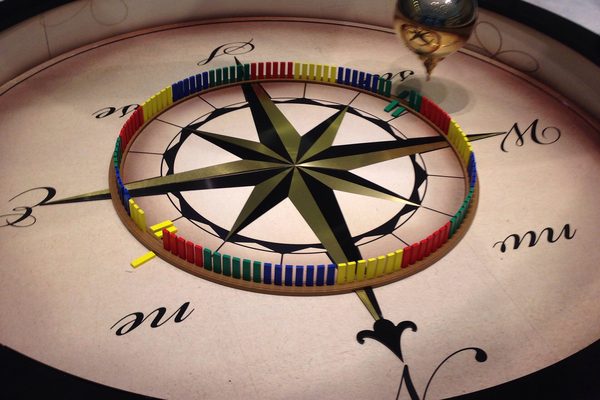
The brass bob of a Foucault pendulum swinging above a circular dial ringed with small pegs

Photo: Stephen Rahn, CC0 1.0 Universal Public Domain Dedication. Image credits

Overview

Simple harmonic motion happens whenever the restoring force on an object is proportional to its displacement from equilibrium and points back toward equilibrium. A mass on a spring is the cleanest example: F = −k x. A pendulum swinging through small angles behaves almost the same way.

The motion repeats with a period T that depends on the system, not on how far you pull it back. For a mass on a spring, the period depends on the mass and on the spring's stiffness. For a pendulum, it depends on the length and on g. In both cases the amplitude doesn't affect the period, as long as a pendulum's angle stays small.

Energy moves back and forth between kinetic and potential. At the ends of the motion the object is momentarily at rest, the potential energy is greatest, and so is the acceleration. At equilibrium the speed is greatest and the acceleration is zero. The total energy is proportional to the square of the amplitude.

Key equations

EquationWhat it’s for
Fs = −k xHooke’s law. The force points opposite the displacement.
Ts = 2 π √(m/k)Period of a mass on a spring.
Tp = 2 π √(L/g)Period of a simple pendulum swinging through small angles.
f = 1/TFrequency in hertz (cycles per second).
E = ½ k A2Total energy of a mass–spring oscillator with amplitude A.
x = A cos (2 π f t)Position over time when the object is released from x = A at t = 0.

All of these are on the printable equation sheet.

Common mistakes

  • Thinking a larger amplitude means a longer period.
  • Thinking a heavier pendulum bob changes the period. Only the length and g matter.
  • Putting the maximum speed at the ends of the motion. Speed is greatest at equilibrium; acceleration is greatest at the ends.
  • Mixing up period (seconds per cycle) and frequency (cycles per second).
  • Using the constant-acceleration kinematics equations for an oscillator. The acceleration changes as the position changes.

Practice problems

Work each problem on paper before opening its solution. Multiple-select problems have exactly two correct answers.

1Problem 1, Multiple select

  • Which changes

A block attached to a horizontal spring oscillates on a frictionless surface. Which two changes would increase the period of the oscillation? Select two answers.

  1. Choice A: Replace the block with a heavier block.
  2. Choice B: Pull the block farther from equilibrium before releasing it.
  3. Choice C: Replace the spring with a less stiff spring.
  4. Choice D: Take the whole setup to the Moon.
Show solutionHide solution

Worked solution

For a mass on a spring, T = 2 π √(m/k).

A heavier block (larger m) increases the period. A less stiff spring (smaller k) also increases the period. A and C are correct.

Amplitude doesn't appear in the formula (B). For a horizontal spring, gravity doesn't affect the restoring force, so the Moon doesn't change the period (D).

Answers: A and C.

2Problem 2, Multiple choice

  • Which changes
  • Calculation

A pendulum has a period of 2.0 s on Earth. On the Moon, where g is about 1/6 as large, its period would be about

  1. Choice A: 0.33 s
  2. Choice B: 0.82 s
  3. Choice C: 4.9 s
  4. Choice D: 12 s
Show solutionHide solution

Worked solution

T = 2 π √(L/g), so the period is proportional to 1/√(g).

Dividing g by 6 multiplies the period by √(6) ≈ 2.45: (2.0)(2.45) ≈ 4.9 s.

Choice D multiplies by 6 instead of by √(6). Choices A and B make the period shorter, but weaker gravity pulls the bob back more gently, so the pendulum swings more slowly.

Answer: C.

3Problem 3, Multiple choice

  • Calculation

A 0.50 kg block oscillates on a spring with a spring constant of 200 N/m. What is the period?

  1. Choice A: 0.050 s
  2. Choice B: 0.31 s
  3. Choice C: 3.2 s
  4. Choice D: 0.010 s
Show solutionHide solution

Worked solution

T = 2 π √(m/k) = 2 π √(0.50/200) = 2 π √(0.0025) = 2 π (0.050) ≈ 0.31 s.

Choice A forgets the 2π. Choice C is the frequency, 1/T, in hertz.

Answer: B.

4Problem 4, Multiple select

  • Graph

The graph shows the position of a block oscillating on a spring. Which two statements are correct? Select two answers.

00.511.522.533.54−0.10−0.0500.050.10time (s)position (m)
  1. Choice A: At t = 1.0 s the block is momentarily at rest.
  2. Choice B: At t = 0.5 s the block’s speed is greatest.
  3. Choice C: At t = 0.5 s the magnitude of the block’s acceleration is greatest.
  4. Choice D: The frequency of the oscillation is 2.0 Hz.
Show solutionHide solution

Worked solution

At t = 1.0 s the graph is at its lowest point, x = −0.10 m. The slope there is zero, so the velocity is zero. A is correct.

At t = 0.5 s the block is at x = 0, equilibrium. The graph is steepest there, so the speed is greatest. B is correct.

At equilibrium the spring force is zero, so the acceleration is zero, not greatest. C is wrong.

One full cycle takes 2.0 s, so the period is 2.0 s and the frequency is 1/2.0 = 0.50 Hz. D is wrong.

Answers: A and B.

5Problem 5, Multiple choice

  • Which changes

The amplitude of a mass–spring oscillator is doubled. What happens to the total mechanical energy and to the maximum speed?

  1. Choice A: Energy doubles; maximum speed doubles.
  2. Choice B: Energy is four times as large; maximum speed doubles.
  3. Choice C: Energy is four times as large; maximum speed is four times as large.
  4. Choice D: Energy doubles; maximum speed increases by a factor of √2.
Show solutionHide solution

Worked solution

Total energy: E = ½ k A2. Doubling A makes E four times larger.

At equilibrium all of the energy is kinetic: ½ m vmax2 = ½ k A2, so vmax = A √(k/m). The maximum speed is proportional to A, so it doubles.

The period doesn't change, but the block covers twice the distance in the same time, which is another way to see that it moves twice as fast.

Answer: B.

6Problem 6, Free response

  • Ranking
  • Paragraph argument
Four simple pendulums swing through small angles.
PendulumLengthBob mass
A1.0 m1.0 kg
B1.0 m2.0 kg
C4.0 m1.0 kg
D0.25 m3.0 kg
  1. Rank the pendulums by period, from longest to shortest.
  2. Explain in a few sentences why the mass of the bob doesn't affect the period.
  3. Calculate the period of pendulum C.
Show solutionHide solution

Model answer

(a) T = 2 π √(L/g) depends only on length. Four times the length gives twice the period. Ranking: C > A = B > D.

(b) A heavier bob feels a larger gravitational force pulling it back toward the bottom, but it also has more inertia, so it's harder to accelerate. The two effects cancel exactly, just as all objects fall with the same acceleration. So the bob's acceleration at any position, and therefore the period, doesn't depend on its mass.

(c) TC = 2 π √(4.0/10) ≈ 4.0 s. (For comparison, A and B: about 2.0 s, and D: about 0.99 s.)

7Problem 7, Free response

  • Experimental design
  • Graph
Students want to find the spring constant of a spring in two different ways. They have the spring, a set of hanging masses, a meterstick, a stand, and a stopwatch.
  1. Static method: describe how to find k by hanging masses at rest, including what to graph.
  2. Dynamic method: describe how to find k by timing oscillations. What should they graph to get a straight line?
  3. Using the dynamic method, the students get a slope of 0.20 s²/kg. Find k.
Show solutionHide solution

Model answer

(a) Hang several different masses and, for each, measure how far the spring stretches from its unloaded length once the mass is at rest. At rest, the spring force equals the weight, k x = m g. Graph the weight (m g) on the vertical axis against the stretch x. The slope is k.

(b) For each mass, pull it down a little, release it, and time 10 full oscillations. Divide by 10 to get the period, which reduces the effect of reaction time. Since T2 = (4 π2/k) m, a graph of T2 against m is a straight line with slope 4 π2/k.

(c) k = 4 π2 / 0.20 ≈ 2.0 × 10² N/m (about 197 N/m).

If the spring itself has noticeable mass, the T2 line won't pass exactly through the origin, but the slope still gives k.

8Problem 8, Multiple choice

  • Conceptual

Which statement best describes the acceleration of a block oscillating on a spring?

  1. Choice A: It is constant, like the acceleration of a falling object.
  2. Choice B: It is greatest when the block passes through equilibrium.
  3. Choice C: It is proportional to the block’s displacement and points toward equilibrium.
  4. Choice D: It always points in the direction of the block’s velocity.
Show solutionHide solution

Worked solution

Newton's second law with Hooke's law: m a = −k x, so a = −(k/m) x.

The acceleration is proportional to the displacement, and the minus sign means it points back toward equilibrium. It is greatest at the ends and zero at equilibrium, so B is wrong. It isn't constant, so A is wrong.

On the way out from equilibrium, the block slows down: its acceleration points opposite its velocity. D is wrong.

Answer: C.

9Problem 9, Free response

  • Graph
  • Calculation
The graph shows the force needed to stretch a spring by different amounts.
  1. Find the spring constant.
  2. Use the graph to find the energy stored in the spring when it is stretched 0.30 m.
  3. The spring is placed horizontally and attached to a 0.60 kg cart on a frictionless track. The cart is pulled 0.30 m from equilibrium and released. Find its maximum speed.
00.050.100.150.200.250.300.35036912stretch, x (m)force, F (N)
Show solutionHide solution

Model answer

(a) The spring constant is the slope: k = 12/0.30 = 40 N/m.

(b) The stored energy is the area under the graph: ½(0.30)(12) = 1.8 J. Check: ½ k x2 = ½(40)(0.30)2 = 1.8 J.

(c) At equilibrium all 1.8 J is kinetic energy: ½(0.60) v2 = 1.8, so v2 = 6.0 and v ≈ 2.4 m/s.

10Problem 10, Free response

  • Paragraph argument
A student says, “If I pull a pendulum back farther, it has to travel a longer path, so each swing will take longer.”
  1. Write a short paragraph explaining why this reasoning is incomplete for a pendulum swinging through small angles.
  2. Describe what actually happens to the period at large angles, such as 60°.
Show solutionHide solution

Model answer

(a) Sample paragraph: The student is right that a larger amplitude means a longer path, but leaves out the speed. When the pendulum starts farther from the bottom, the restoring force on it is larger, so it accelerates more and reaches higher speeds. For small angles the restoring force is proportional to the displacement, so the extra speed exactly makes up for the extra distance. The period stays the same no matter the amplitude. That's why pendulums are good timekeepers.

(b) At large angles the restoring force grows a little more slowly than the displacement, so the balance isn't exact. The period becomes slightly longer than 2 π √(L/g). At 60° it is about 7% longer. The student's idea is partly right for big swings, but for a different reason.