Physics 1 Practice

Unit 5 of 8

Linear Momentum

Momentum, impulse, force–time graphs, conservation of momentum, and elastic and inelastic collisions.

10 problems: 5 multiple choice, 1 multiple select, 4 free response. Use g = 10 m/s² throughout.

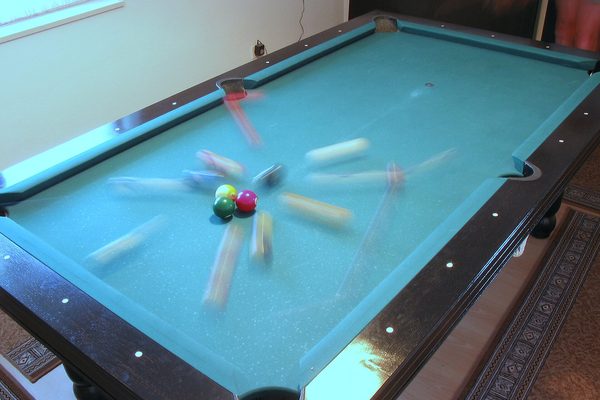
A long-exposure photo of a billiards break shot, with blurred balls streaking outward across a blue table

Photo: Kucharek, Public domain. Image credits

Overview

Momentum, p = m v, is a vector with the same direction as the velocity. Changing an object's momentum takes an impulse: a force acting over a time interval. The same change in momentum can come from a large force acting briefly or a smaller force acting longer. That's why airbags, padded floors, and bending your knees when you land all reduce injuries.

When the net external force on a system is zero, or tiny compared with the forces inside it during a quick collision, the system's total momentum stays constant. Inside the system, the objects push on each other with equal and opposite forces for the same length of time, so whatever momentum one object gains, the other loses.

Momentum is conserved in every collision, but kinetic energy isn't. In an elastic collision, the total kinetic energy after equals the total before. In an inelastic collision, some kinetic energy becomes thermal energy, sound, and permanent deformation. When the objects stick together, the collision is perfectly inelastic and loses the most kinetic energy.

Key equations

EquationWhat it’s for
p = m vMomentum. A vector, so keep track of signs.
J = Favg Δ t = Δ pImpulse equals the change in momentum.
J = area under an F–t graphUse this when the force changes during the interaction.
Σ pbefore = Σ pafterConservation of momentum, when the net external force is zero.
vcm = (m1 v1 + m2 v2)/(m1 + m2)Velocity of a two-object system’s center of mass.
Kbefore = KafterOnly for elastic collisions.

All of these are on the printable equation sheet.

Common mistakes

  • Forgetting that momentum is a vector. A ball that bounces back has a larger change in momentum than one that stops.
  • Assuming kinetic energy is conserved in every collision.
  • Thinking the more massive object exerts the larger force in a collision. The forces are equal and opposite. The effects differ because the masses differ.
  • Using conservation of momentum for a system that has a large outside force on it, such as a single ball falling under gravity.
  • Thinking a longer stopping time reduces the change in momentum. It reduces the average force. The change in momentum depends only on the starting and ending velocities.

Practice problems

Work each problem on paper before opening its solution. Multiple-select problems have exactly two correct answers.

1Problem 1, Free response

  • Calculation
  • Predict & explain
A 2.0 kg cart moving at 3.0 m/s on a level, low-friction track hits a 1.0 kg cart at rest. The carts stick together.
  1. Find the velocity of the carts after the collision.
  2. Find the kinetic energy before and after. How much kinetic energy was lost?
  3. Where did that energy go?
  4. Suppose instead the 1.0 kg cart moves at 3.0 m/s and hits the 2.0 kg cart at rest, and they stick. Predict, before calculating, whether the final speed is greater than, less than, or equal to your answer to part (a). Then check.
Show solutionHide solution

Model answer

(a) Momentum is conserved: (2.0)(3.0) + 0 = (3.0) v, so v = 2.0 m/s in the original direction.

(b) Before: ½(2.0)(3.0)2 = 9.0 J. After: ½(3.0)(2.0)2 = 6.0 J. Lost: 3.0 J.

(c) It became thermal energy, sound, and any permanent deformation of the bumpers. It didn't vanish; it left the form of kinetic energy.

(d) Less. The total momentum is now only (1.0)(3.0) = 3.0 kg·m/s, half as much as before, shared by the same 3.0 kg. Check: v = 3.0/3.0 = 1.0 m/s.

2Problem 2, Multiple choice

  • Graph
  • Calculation

A 0.50 kg soccer ball at rest is kicked. The graph shows the force of the foot on the ball. What is the ball’s speed just after the kick?

00.010.020.030.040.050.060100200300400time (s)force on ball (N)
  1. Choice A: 10 m/s
  2. Choice B: 20 m/s
  3. Choice C: 40 m/s
  4. Choice D: 0.20 m/s
Show solutionHide solution

Worked solution

Impulse is the area under the force–time graph: ½(0.050)(400) = 10 N·s.

Impulse equals the change in momentum, and the ball starts at rest: 0.50 v = 10, so v = 20 m/s.

Choice A gives the impulse instead of the speed. Choice C treats the area as a rectangle.

Answer: B.

3Problem 3, Multiple select

  • Conceptual

An egg dropped onto a pillow survives, while the same egg dropped from the same height onto a tile floor breaks. Assume the egg doesn’t bounce in either case. Which two statements are correct? Select two answers.

  1. Choice A: The egg’s change in momentum is the same in both cases.
  2. Choice B: The pillow increases the time it takes the egg to stop.
  3. Choice C: The pillow reduces the impulse on the egg.
  4. Choice D: The egg has less momentum just before it hits the pillow.
Show solutionHide solution

Worked solution

Both eggs fall the same height, so they arrive with the same speed and momentum. Both end at rest. The change in momentum, and therefore the impulse, is the same. A is correct and C and D are wrong.

The pillow squashes, so the egg takes longer to stop. Since Favg = Δ p / Δ t, a longer time means a smaller average force on the egg. B is correct, and that's why the egg survives.

Answers: A and B.

4Problem 4, Free response

  • Ranking
  • Paragraph argument
Four carts move along the same straight track. Positive is to the right.
CartMassVelocity
A2.0 kg+3.0 m/s
B1.0 kg+8.0 m/s
C4.0 kg+1.0 m/s
D3.0 kg−2.0 m/s
  1. Rank the carts by the magnitude of their momentum, from greatest to least.
  2. Rank the carts by kinetic energy, from greatest to least.
  3. Two of the carts have momentum of the same magnitude but different kinetic energies. Explain how that is possible.
Show solutionHide solution

Model answer

(a) |p| = m|v|. A: 6.0 kg·m/s. B: 8.0. C: 4.0. D: 6.0. Ranking: B > A = D > C. Direction doesn't affect the magnitude.

(b) K = ½ m v2. A: 9.0 J. B: 32 J. C: 2.0 J. D: 6.0 J. Ranking: B > A > D > C.

(c) A and D have the same momentum magnitude. Kinetic energy can be written K = p2/2m, so for the same momentum, the object with less mass has more kinetic energy. A has less mass and a higher speed, and speed is squared in kinetic energy, so A has more kinetic energy than D.

5Problem 5, Multiple choice

  • Calculation

Two ice skaters, 50 kg and 75 kg, stand at rest facing each other and push apart. Afterward the 50 kg skater moves at 3.0 m/s. Ignoring friction, what is the velocity of the 75 kg skater?

  1. Choice A: 2.0 m/s, opposite the 50 kg skater
  2. Choice B: 3.0 m/s, opposite the 50 kg skater
  3. Choice C: 4.5 m/s, opposite the 50 kg skater
  4. Choice D: 2.0 m/s, in the same direction as the 50 kg skater
Show solutionHide solution

Worked solution

The skaters start at rest, so the total momentum is zero before and after the push.

(50)(3.0) + (75) v = 0, so v = −150/75 = −2.0 m/s. The negative sign means the opposite direction.

The push forces on the two skaters are equal and opposite and last the same time, so they get equal and opposite momenta. The heavier skater moves more slowly.

Answer: A.

6Problem 6, Multiple choice

  • Conceptual

A rubber ball and a lump of clay with the same mass are thrown at a wall with the same speed. The rubber ball bounces straight back at nearly the same speed, and the clay sticks to the wall. Which object receives the greater impulse from the wall?

  1. Choice A: The rubber ball
  2. Choice B: The clay
  3. Choice C: Both receive the same impulse
  4. Choice D: It can’t be determined without knowing how long each one touches the wall
Show solutionHide solution

Worked solution

Impulse equals the change in momentum. Take the direction toward the wall as positive.

Clay: from +m v to 0, so Δ p = −m v.

Rubber ball: from +m v to about −m v, so Δ p ≈ −2 m v, nearly twice as much.

You don't need the contact time. It would tell you the average force, not the impulse.

Answer: A.

7Problem 7, Multiple choice

  • Predict & explain

A cart moving at 2.0 m/s collides head-on and elastically with an identical cart at rest on a level, low-friction track. What happens right after the collision?

  1. Choice A: Both carts move forward at 1.0 m/s.
  2. Choice B: The first cart stops and the second moves forward at 2.0 m/s.
  3. Choice C: The first cart bounces back at 2.0 m/s and the second stays at rest.
  4. Choice D: Both carts move forward at 2.0 m/s.
Show solutionHide solution

Worked solution

An elastic collision must conserve both momentum and kinetic energy. Before: p = 2m and K = ½ m (2)2 = 2m, in units where m is each cart's mass.

A: p = m + m = 2m, but K = 2(½ m (1)2) = m. Kinetic energy is lost, so it's inelastic.

B: p = 2m and K = ½ m (2)2 = 2m. Both are conserved.

C: p = −2m, which isn't conserved. D: p = 4m, which isn't conserved either.

Answer: B. This is what a Newton's cradle shows.

8Problem 8, Free response

  • Graph
  • Calculation
The graph shows the velocities of two carts that collide on a level, low-friction track. Cart A has a mass of 1.0 kg.
  1. Use the graph to find the mass of cart B.
  2. Is the collision elastic? Support your answer with calculations.
  3. Compare the size of the force cart B exerts on cart A with the force cart A exerts on cart B during the collision. Explain how the graph supports your answer.
00.40.81.21.622.401234time (s)velocity (m/s)cart Acart B
Show solutionHide solution

Model answer

(a) Before the collision the total momentum is (1.0)(4.0) + 0 = 4.0 kg·m/s. After: (1.0)(1.0) + mB (1.5). Setting them equal: mB = 3.0/1.5 = 2.0 kg.

(b) Before: K = ½(1.0)(4.0)2 = 8.0 J. After: ½(1.0)(1.0)2 + ½(2.0)(1.5)2 = 0.50 + 2.25 = 2.75 J. Kinetic energy decreased, so the collision is inelastic.

(c) The forces are equal in size (Newton's third law). The graph agrees: during the same 0.20 s, cart A's velocity changes by 3.0 m/s and cart B's by 1.5 m/s. Cart B's mass is twice as large, so equal forces give cart B half the change in velocity. The momentum changes are equal and opposite: −3.0 and +3.0 kg·m/s.

9Problem 9, Free response

  • Experimental design
Design an experiment to determine whether a collision between two carts with magnetic bumpers is elastic. You have two carts, a level low-friction track, two motion sensors (one at each end), and a balance.
  1. Describe your procedure, including what you measure.
  2. Explain how you would use your data to decide whether the collision is elastic.
  3. Your measurements will never match perfectly. Describe how you would decide whether a small difference matters.
Show solutionHide solution

Model answer

(a) Measure each cart's mass with the balance. Place one cart at rest in the middle of the track and push the other toward it. Use the motion sensors to record each cart's velocity just before and just after the collision. Repeat for several starting speeds, and with the roles switched.

(b) Calculate the total kinetic energy, ½ m1 v12 + ½ m2 v22, before and after each collision. If the collision is elastic, the two totals are equal. As a check on your measurements, also confirm that the total momentum is about the same before and after.

(c) Compare the size of the difference with the uncertainty of your measurements. For example, if repeated trials show the speed readings vary by about 2%, kinetic energy (which depends on v2) could vary by about 4%. A ratio of Kafter/Kbefore of 0.97 would count as elastic within uncertainty. A ratio that is consistently 0.80 would not.

10Problem 10, Multiple choice

  • Conceptual

A ball falls from a shelf. While it falls, is the ball’s momentum conserved?

  1. Choice A: Yes, because the ball doesn’t collide with anything while it falls.
  2. Choice B: No, because gravity is an external force on the ball. Momentum is conserved for the ball–Earth system.
  3. Choice C: Yes, because mechanical energy is conserved during the fall.
  4. Choice D: No, because momentum is never conserved when gravity acts.
Show solutionHide solution

Worked solution

The ball speeds up as it falls, so its momentum increases. It is not conserved.

The reason: Earth's gravitational pull is an external force on a system that contains only the ball.

If the system is the ball and Earth together, gravity is internal. The ball pulls up on Earth as hard as Earth pulls down on the ball, so Earth gains an equal and opposite (and unnoticeably small) momentum. The ball–Earth system's momentum is conserved. That's why D is wrong.

Answer: B.