Physics 1 Practice

Unit 4 of 8

Work and Energy

Kinetic and potential energy, work, the work–energy theorem, conservation of energy, and power.

10 problems: 4 multiple choice, 2 multiple select, 4 free response. Use g = 10 m/s² throughout.

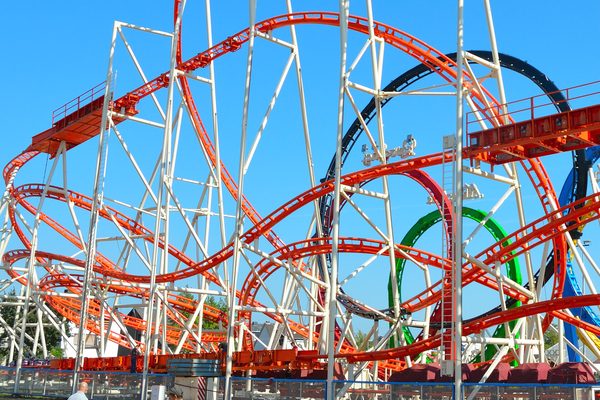
Red steel roller coaster track twisting through several vertical loops against a blue sky

Photo: Spielvogel, CC0 1.0 Universal Public Domain Dedication. Image credits

Overview

Energy is a way of keeping score. Instead of tracking forces moment by moment, you compare a system's energy at two instants and account for any energy that came in or went out. Kinetic energy, ½ m v2, is energy of motion. Gravitational potential energy, m g h, belongs to the object–Earth system, and spring potential energy, ½ k x2, is stored in a stretched or compressed spring.

Work is how a force moves energy into or out of a system: W = F d cos θ. Only the part of the force along the displacement does work. A force perpendicular to the motion, like the normal force on a box sliding across a floor, does no work at all.

If no outside forces do work on a system and there's no friction inside it, the system's mechanical energy stays constant. Friction turns mechanical energy into thermal energy, so the mechanical energy decreases. Before you write an equation, decide what's in your system. That decision tells you which energies to track and which forces count as outside work.

Key equations

EquationWhat it’s for
K = ½ m v2Kinetic energy. It depends on speed, not direction.
Ug = m g hGravitational potential energy, with h measured from a reference level you choose.
Us = ½ k x2Energy stored in a spring stretched or compressed by x.
W = F d cos θWork by a constant force. θ is the angle between the force and the displacement.
Wnet = Δ KWork–energy theorem: the net work equals the change in kinetic energy.
P = W / Δ tAverage power. For a constant force along the motion, also P = F v.

All of these are on the printable equation sheet.

Common mistakes

  • Treating energy as a vector. Kinetic energy depends only on speed, so the direction of motion never matters.
  • Thinking a heavier object reaches the bottom of a frictionless ramp moving faster. Mass cancels: v = √(2 g h).
  • Saying a force does work just because it acts. A force does work only if the object moves with a component along the force.
  • Forgetting that kinetic energy depends on speed squared. Twice the speed means four times the kinetic energy.
  • Leaving out friction's work when a surface is rough. That energy hasn't disappeared. It has become thermal energy.

Practice problems

Work each problem on paper before opening its solution. Multiple-select problems have exactly two correct answers.

1Problem 1, Multiple choice

  • Predict & explain

Three identical balls are launched from the edge of a cliff with the same speed. One is launched straight up, one horizontally, and one straight down. Ignore air resistance. Which ball is moving fastest when it reaches the ground below?

  1. Choice A: The ball launched straight up
  2. Choice B: The ball launched horizontally
  3. Choice C: The ball launched straight down
  4. Choice D: All three hit the ground at the same speed
Show solutionHide solution

Worked solution

Use energy. Each ball starts with the same kinetic energy (same mass and speed) and the same gravitational potential energy (same height).

Each ball loses the same m g h on the way down, so each gains the same kinetic energy and lands with the same speed. Direction doesn't enter into kinetic energy.

The balls do land at different times and in different directions, just not at different speeds.

Answer: D.

2Problem 2, Free response

  • Graph
  • Conceptual
A cart is released from rest at height h on a frictionless track and rolls downhill. Use the cart–Earth system, with Ug = 0 at the bottom of the track.
  1. Draw energy bar charts showing K, Ug, and the total energy at the release point and at height h/4.
  2. At height h/4, what fraction of its speed at the bottom of the track does the cart have? Explain.
Show solutionHide solution

Model answer

At release (height h)K0Ug4Total4At height h/4K3Ug1Total4

(a) Call the total energy 4 units. At release: K = 0, Ug = 4. At h/4 the potential energy is one-fourth as much, so Ug = 1. There's no friction, so the total stays 4, which leaves K = 3.

(b) At the bottom all 4 units are kinetic. At h/4 the cart has 3 of those 4 units. Kinetic energy is proportional to v2, so v2 is ¾ of its bottom value and v = √(3/4) ≈ 0.87 of the speed at the bottom.

Notice that the cart has three-fourths of the kinetic energy but almost 90% of the speed.

3Problem 3, Multiple choice

  • Which changes

A spring launcher shoots a ball horizontally across a frictionless table. When the spring is compressed 3.0 cm, the ball leaves at speed v. If the spring is compressed 6.0 cm instead, the ball leaves at

  1. Choice A: √(2) v
  2. Choice B: 2 v
  3. Choice C: 4 v
  4. Choice D: v
Show solutionHide solution

Worked solution

The spring's stored energy becomes the ball's kinetic energy: ½ k x2 = ½ m v2, so v = x √(k/m).

The speed is proportional to the compression. Doubling x doubles v.

Choice C confuses speed with energy: the stored energy does quadruple.

Answer: B.

4Problem 4, Free response

  • Calculation
  • Which changes
A 2.0 kg block slides across a rough, level floor. It is moving at 6.0 m/s at one moment and comes to rest 4.5 m later.
  1. How much work does friction do on the block?
  2. Find the friction force and the coefficient of kinetic friction.
  3. If the block started at 12 m/s on the same floor, how far would it slide? Answer with a ratio argument instead of recalculating the force.
Show solutionHide solution

Model answer

(a) The work done by friction equals the change in kinetic energy: W = 0 − ½(2.0)(6.0)2 = −36 J.

(b) W = −f d, so f = 36/4.5 = 8.0 N. The normal force is (2.0)(10) = 20 N, so μk = 8.0/20 = 0.40.

(c) Doubling the speed gives four times the kinetic energy. The friction force is the same, so the block has to slide four times as far to lose all that energy: 4 × 4.5 = 18 m.

5Problem 5, Multiple choice

  • Graph
  • Calculation

A 5.0 kg object starts from rest on a frictionless, level surface. A horizontal force pushes it in the direction of motion. The graph shows how the force changes with position. What is the object’s speed at x = 6 m?

01234560246810position, x (m)force, F (N)
  1. Choice A: 2.8 m/s
  2. Choice B: 4.0 m/s
  3. Choice C: 4.9 m/s
  4. Choice D: 16 m/s
Show solutionHide solution

Worked solution

Work is the area under a force–position graph. Rectangle from 0 to 2 m: (10)(2) = 20 J. Triangle from 2 to 6 m: ½(4)(10) = 20 J. Total: 40 J.

The object starts from rest, so all 40 J becomes kinetic energy: ½(5.0) v2 = 40, so v2 = 16 and v = 4.0 m/s.

Choice A uses only the first 20 J. Choice C treats the whole area as a 10 N by 6 m rectangle. Choice D forgets to take the square root.

Answer: B.

6Problem 6, Multiple select

  • Conceptual

Two students with the same mass climb the same flight of stairs. Student A takes 20 s and student B takes 10 s. Which two statements are correct? Select two answers.

  1. Choice A: Both students do the same amount of work against gravity.
  2. Choice B: Student B does twice as much work as student A.
  3. Choice C: Student B’s average power is twice student A’s.
  4. Choice D: Student A’s average power is twice student B’s.
Show solutionHide solution

Worked solution

Both students gain the same gravitational potential energy, m g h, so they do the same work against gravity. A is correct and B is wrong.

Power is work divided by time. B does the same work in half the time, so B's power is twice A's. C is correct and D is wrong.

Answers: A and C.

7Problem 7, Multiple select

  • Conceptual

In which two situations does the named force do zero work on the object? Select two answers.

  1. Choice A: The normal force on a box sliding down a ramp
  2. Choice B: Gravity on a satellite in a circular orbit
  3. Choice C: Friction on a box sliding across a floor
  4. Choice D: Gravity on a ball falling from a shelf
Show solutionHide solution

Worked solution

Work is F d cos θ. It's zero when the force is perpendicular to the displacement (θ = 90°).

The normal force on the box is perpendicular to the ramp, and the box moves along the ramp. Zero work. A is correct.

In a circular orbit, gravity points toward the planet's center and the satellite moves along the circle, always at 90° to the force. Zero work, which is why the satellite's speed stays constant. B is correct.

Friction opposes the sliding, so it does negative work (C). Gravity points the same way the ball falls, so it does positive work (D).

Answers: A and B.

8Problem 8, Multiple choice

  • Calculation

A pendulum bob is pulled aside and released from rest 0.45 m above its lowest point. Ignoring air resistance, what is the bob’s speed at the lowest point?

  1. Choice A: 3.0 m/s
  2. Choice B: 4.5 m/s
  3. Choice C: 9.0 m/s
  4. Choice D: 2.1 m/s
Show solutionHide solution

Worked solution

The string's tension is always perpendicular to the bob's motion, so it does no work. Mechanical energy is conserved.

m g h = ½ m v2, and the mass cancels: v = √(2 g h) = √(2(10)(0.45)) = √(9.0) = 3.0 m/s.

Choice D leaves out the 2. Choice C forgets the square root.

Answer: A.

9Problem 9, Free response

  • Experimental design
  • Graph
A student wants to test whether mechanical energy is conserved for a cart rolling down a ramp from different heights. She has a cart, an adjustable ramp, a photogate and timer at the bottom of the ramp, a flag of known width mounted on the cart, a balance, and a meterstick.
  1. Describe what she should measure and how.
  2. Explain what she should graph, and what the graph would look like if mechanical energy were conserved.
  3. Describe how the graph would differ if friction removed a noticeable amount of energy.
Show solutionHide solution

Model answer

(a) For each trial, measure the vertical height h of the cart's release point above the photogate with the meterstick. Release the cart from rest. The photogate measures the time Δ t for the flag to pass through, so the speed at the bottom is v = w/Δ t, where w is the flag's width. Repeat for at least five heights, with several trials at each.

(b) If energy is conserved, m g h = ½ m v2, so v2 = 2 g h. Graph v2 against h. The points should fall on a straight line through the origin with slope 2g, about 20 m/s². The mass cancels, so she doesn't need the balance for this test.

(c) With friction, part of the energy becomes thermal energy, so v2 falls below 2gh at every height. The slope would be noticeably less than 20 m/s². The spinning wheels also store a little kinetic energy, which can make the slope slightly low even with very little friction.

10Problem 10, Free response

  • Paragraph argument
A roller coaster car starts from rest at the top of a hill of height H. The track dips down and then rises to a second hill that is also of height H. A student claims, “Because the hills are the same height, the car will just make it to the top of the second hill.”
  1. Evaluate the claim for an ideal, frictionless track.
  2. Evaluate the claim for a real track. Write your answer as a short paragraph that uses energy.
  3. Describe one change that would let a real car make it over the second hill.
Show solutionHide solution

Model answer

(a) On a frictionless track the car–Earth system keeps all of its mechanical energy. The car started at rest at height H, so it can reach height H again, but only with zero speed. In that ideal case the claim is right: the car just reaches the top.

(b) Sample paragraph: On a real track, friction between the wheels and the track and air resistance do negative work on the car the whole time. Some of the system's mechanical energy becomes thermal energy. When the car arrives at the second hill it has less mechanical energy than it started with, so it can't climb back up to height H. It stops partway up the second hill and rolls back. The claim fails for a real track.

(c) Make the second hill lower than the first, or give the car extra energy at the start, for example with a launch or by having it leave the first hilltop already moving.