Physics 1 Practice

Unit 3 of 8

Circular Motion and Gravitation

Centripetal acceleration, the forces that keep objects on curved paths, Newton’s law of gravitation, and orbits.

10 problems: 7 multiple choice, 1 multiple select, 2 free response. Use g = 10 m/s² throughout.

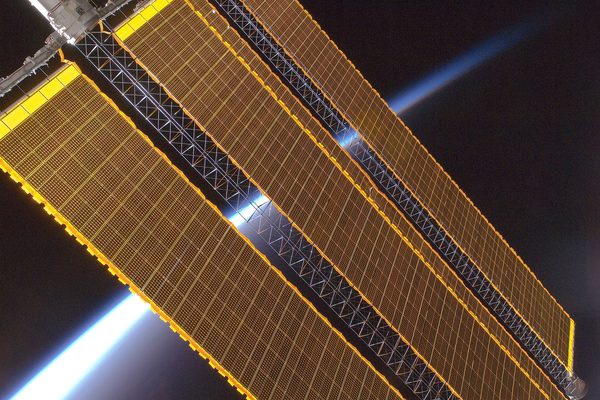
Gold solar panel arrays of the International Space Station against black space, with Earth’s thin blue horizon glowing behind them

Photo: NASA, Public domain. Image credits

Overview

An object moving in a circle at constant speed is still accelerating, because the direction of its velocity keeps changing. That acceleration points toward the center of the circle and has magnitude ac = v2/r. By Newton's second law, something has to provide a net force toward the center: tension, friction, gravity, a normal force, or a combination.

"Centripetal force" isn't a new kind of force. It's a name for the job the net force is doing. On a free-body diagram, draw only the real forces (gravity, tension, normal, friction), then ask which of them, or which components of them, point toward the center.

Gravity is what keeps moons, planets, and satellites in orbit. Every pair of masses attracts each other with a force proportional to the product of the masses and inversely proportional to the square of the distance between their centers. A satellite in orbit is falling the whole time. It is simply moving sideways fast enough that it keeps missing the planet.

Key equations

EquationWhat it’s for
ac = v2 / rCentripetal acceleration, directed toward the center.
Σ Fc = m v2 / rNet force toward the center needed for circular motion.
v = 2 π r / TSpeed of an object that goes around once in a period T.
Fg = G m1 m2 / r2Newton’s law of gravitation. r is measured center to center.
g = G M / R2Gravitational field strength at the surface of a planet of mass M and radius R.
v = √(G M / r)Speed of a circular orbit of radius r. It doesn’t depend on the satellite’s mass.

All of these are on the printable equation sheet.

Common mistakes

  • Adding a separate "centripetal force" to a free-body diagram on top of the real forces.
  • Thinking an object that's released from circular motion flies straight outward. It moves off along the tangent, in the direction it was already moving.
  • Forgetting to square the distance in the law of gravitation, or measuring it from the planet's surface instead of its center.
  • Saying astronauts float because there is no gravity in orbit. At the International Space Station's altitude, gravity is nearly 90% as strong as at the ground.
  • Thinking a heavier satellite needs a different speed for the same orbit. The satellite's mass cancels out.

Practice problems

Work each problem on paper before opening its solution. Multiple-select problems have exactly two correct answers.

1Problem 1, Multiple choice

  • Conceptual

A car drives around a flat, circular track at a constant speed. Which statement describes the car’s acceleration?

  1. Choice A: It is zero, because the speed is constant.
  2. Choice B: It points toward the center of the circle.
  3. Choice C: It points in the direction the car is moving.
  4. Choice D: It points away from the center of the circle.
Show solutionHide solution

Worked solution

Velocity is a vector. Even at a steady speed, the car's direction keeps changing, so its velocity is changing and it is accelerating.

For uniform circular motion that acceleration points toward the center of the circle, with size v2/r. If it pointed along the motion, the car would speed up.

Answer: B.

2Problem 2, Multiple choice

  • Predict & explain

A ball on a string is swung in a horizontal circle, shown from above. The string breaks when the ball is at point P. Which describes the ball’s path right after the string breaks, as seen from above?

OPmotion
  1. Choice A: A straight line directly away from O
  2. Choice B: A straight line tangent to the circle, in the direction the ball was moving
  3. Choice C: A curve that continues around the circle and slowly spirals outward
  4. Choice D: A straight line toward O
Show solutionHide solution

Worked solution

While the string is attached, its tension pulls the ball toward O and keeps bending its path.

Once the string breaks, no horizontal force acts on the ball. By Newton's first law it keeps moving with the velocity it had at P, in a straight line.

At P the ball was moving tangent to the circle. With counterclockwise motion, that's straight "up" in the diagram.

Answer: B. Nothing pushes the ball outward, so A is wrong.

3Problem 3, Free response

  • Ranking
Four cars, each with a mass of 1000 kg, round curves at constant speed on flat roads.
CarSpeedRadius of curve
A10 m/s20 m
B20 m/s40 m
C10 m/s10 m
D20 m/s80 m
  1. Rank the cars by the size of their centripetal acceleration, from greatest to least.
  2. Which car or cars need the largest friction force from the road? Explain, and find that force.
Show solutionHide solution

Model answer

(a) ac = v2/r. A: 100/20 = 5.0 m/s². B: 400/40 = 10 m/s². C: 100/10 = 10 m/s². D: 400/80 = 5.0 m/s².

Ranking: B = C > A = D. Doubling the speed multiplies the acceleration by 4. Doubling the radius cuts it in half.

(b) On a flat road, static friction is the only horizontal force, so it supplies the whole centripetal force, f = m ac. All the cars have the same mass, so B and C need the most: f = (1000)(10) = 1.0 × 10⁴ N.

4Problem 4, Multiple choice

  • Calculation

A roller coaster car goes over the top of a vertical loop of radius 10 m, upside down on the inside of the track. What is the minimum speed at the top for the car to stay in contact with the track?

r = 10 m
  1. Choice A: 1.0 m/s
  2. Choice B: 7.1 m/s
  3. Choice C: 10 m/s
  4. Choice D: 100 m/s
Show solutionHide solution

Worked solution

At the top, both gravity and the normal force from the track point down, toward the center of the loop: m g + FN = m v2/r.

Going slower means a smaller FN. The minimum speed is the one where FN just reaches zero: m g = m v2/r.

The mass cancels: v = √(g r) = √((10)(10)) = 10 m/s. (7.1 m/s is √(50), which comes from a stray factor of ½.)

Answer: C.

5Problem 5, Multiple choice

  • Which changes

Two asteroids attract each other with a gravitational force F. The mass of one asteroid is doubled, and the distance between their centers is also doubled. What is the new force?

  1. Choice A: F/4
  2. Choice B: F/2
  3. Choice C: F
  4. Choice D: 2F
Show solutionHide solution

Worked solution

Fg = G m1 m2 / r2. Doubling m1 multiplies the force by 2.

Doubling r multiplies the force by 1/22 = 1/4.

Combined: 2 × ¼ = ½, so the new force is F/2.

Answer: B.

6Problem 6, Multiple choice

  • Conceptual

Astronauts on the International Space Station float around the cabin. At the station’s altitude, about 400 km above Earth’s surface, gravity is nearly 90% as strong as at the ground. Which best explains why the astronauts float?

  1. Choice A: There is no gravity in space.
  2. Choice B: The station and the astronauts are both in free fall, accelerating toward Earth at the same rate.
  3. Choice C: The station’s high speed cancels out gravity.
  4. Choice D: The Moon’s gravity balances Earth’s gravity at that altitude.
Show solutionHide solution

Worked solution

Gravity at the station is strong: (RE/(RE + h))2 = (6371/6771)2 ≈ 0.89 of its surface value. So A is wrong.

Gravity is exactly what keeps the station in orbit. The station and everyone in it accelerate toward Earth at the same rate, so the floor never has to push on the astronauts. With no normal force, they feel weightless.

Speed doesn't cancel gravity (C), and the Moon's pull at that altitude is tiny compared with Earth's (D).

Answer: B.

7Problem 7, Multiple choice

  • Which changes
  • Calculation

Planet X has twice Earth’s mass and twice Earth’s radius. A rock weighs 100 N on Earth’s surface. What does it weigh on the surface of Planet X?

  1. Choice A: 25 N
  2. Choice B: 50 N
  3. Choice C: 100 N
  4. Choice D: 200 N
Show solutionHide solution

Worked solution

Surface gravitational field: g = G M / R2.

For Planet X: gX = G(2M)/(2R)2 = (2/4) G M / R2 = ½ gEarth.

The rock's mass doesn't change, so its weight is half as large: 50 N.

Answer: B.

8Problem 8, Free response

  • Paragraph argument
  • Calculation
A car rounds a flat, unbanked curve of radius r at a constant speed.
  1. Describe the forces on the car as you would draw them on a free-body diagram, seen from behind the car with the center of the curve to the left.
  2. In a short paragraph, explain what keeps the car moving on the curve and why the car is more likely to skid on an icy road.
  3. Derive an expression for the maximum safe speed in terms of μs, g, and r. Use it to decide whether a fully loaded truck can take the curve faster than, slower than, or at the same speed as an empty one, according to this model.
Show solutionHide solution

Model answer

(a) Weight, m g, down. Normal force from the road, up, equal in size to the weight. Static friction from the road on the tires, horizontal, pointing left, toward the center of the curve.

(b) Sample paragraph: The car needs a net force toward the center of the curve to keep changing direction. On a flat road the only horizontal force is static friction between the tires and the road, so friction supplies the whole centripetal force. Static friction has a maximum value, μs FN. Ice has a much smaller coefficient of friction, so the maximum friction force is smaller. If the car needs more centripetal force than friction can provide, the car can't follow the curve and slides off along a path that's straighter than the curve.

(c) Set the needed force equal to the maximum friction: m v2 / r = μs m g. The mass cancels, so vmax = √(μs g r).

Because mass cancels, this model predicts the same maximum speed for the loaded and empty truck. The extra weight increases the needed centripetal force, but it increases the normal force, and so the available friction, by the same factor. (Real trucks also have to worry about tipping over, which this model leaves out.)

9Problem 9, Multiple choice

  • Graph

The graph shows the gravitational force on a space probe as a function of its distance r from the center of a planet of radius R. At the surface the force is F0. What is the force on the probe at r = 3R?

R2R3R4R0F₀/4F₀distance from planet’s center, rforce on probe
  1. Choice A: F0/3
  2. Choice B: F0/6
  3. Choice C: F0/9
  4. Choice D: F0/27
Show solutionHide solution

Worked solution

The graph shows that at 2R the force is F0/4. Twice the distance gives one-fourth the force, which is what an inverse-square law predicts.

At 3R: F = F0 / 32 = F0/9.

Answer: C.

10Problem 10, Multiple select

  • Conceptual

Two satellites are in circular orbits around the same planet. Satellite 1’s orbit has a smaller radius than satellite 2’s. Which two statements are correct? Select two answers.

  1. Choice A: Satellite 1 moves faster.
  2. Choice B: Satellite 1 has a shorter orbital period.
  3. Choice C: Both move at the same speed, because they orbit the same planet.
  4. Choice D: Satellite 2 has the larger centripetal acceleration.
Show solutionHide solution

Worked solution

For a circular orbit, gravity provides the centripetal force: G M m / r2 = m v2 / r, so v = √(G M / r). A smaller r gives a larger v. A is correct and C is wrong.

The period is T = 2 π r / v. Satellite 1 has a shorter path and moves faster, so its period is shorter. B is correct.

The centripetal acceleration equals the gravitational field, G M / r2, which is larger closer to the planet. That belongs to satellite 1, so D is wrong.

Answers: A and B.